
STAGE
DIRECTIONS
CURTAINS UP ACTING STUDIO
Stage Directions and Parts of the Stage Explained
A guide for teaching stage directions, including upstage, downstage, stage left, stage right, and the basic theater terms students need to begin working with a director.
Watch Explanation of
Stage Directions:
Step-by-step Instructions
Explain to the students that “downstage” is always toward the audience, and “upstage” is away from the audience.
Ask if anyone knows why this is. The answer is: A long time ago when these terms were first used, many stages used to be slanted toward the audience. When you moved toward the audience, you were literally going down. And when you moved away from the audience, you were moving up. Nowadays, most theaters have flat stages–and if anything is slanted, it’s the seats in the audience. But the language remained.
Stage right is always the actors right, when the actor is facing the audience. Stage left is the actors left.
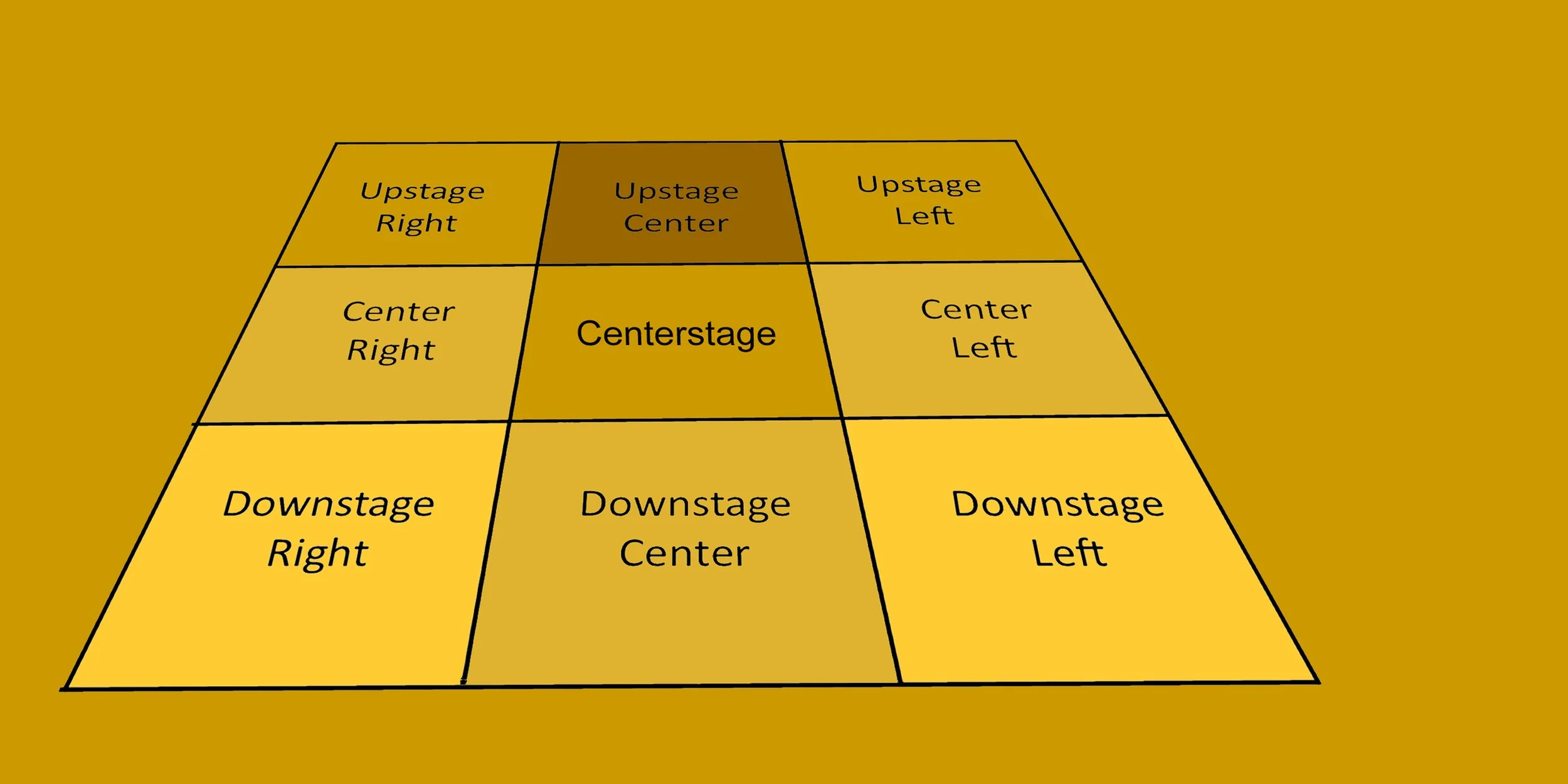
Most large stages can be divided into nine areas by using the four stage directions: upstage, downstage, stage left, and stage right. Those areas are: Downstage left, Downstage center, Downstage right, Center left, Center, Center right, Upstage left, Upstage center, and Upstage right. (Often these are abbreviated to Down Left, Down Center, Down Right, Right, Center, Left, Up Left, Up Center, Up Right.)
In theater, “blocking” is the set of instructions that tell an actor when and where to move on stage. When a director tells an actor where to enter, where to walk, and where to exit–they’re giving that actor their blocking.
Actors need to memorize their blocking just like they have to memorize their lines.The word “cross” when used to describe blocking simply means to move from one place to another on stage. For example, a director might give you this blocking: “I want you to cross from upstage right to downstage left.” It just means he wants you to move on a diagonal from the up right corner of the stage to the down left corner.
MORE THEATER LESSONS YOU MIGHT ENJOY:
STAGE CONVENTIONS FOR MOVEMENT - How to stand and move on stage to stay open to the audience
MIME BASICS - A beginners guide to basic mime concepts
© 2023, Friends of the Groom Theater Company

Curtains Up Curriculum by Friends of the Groom Theater Co. is licensed under a Creative Commons Attribution-NonCommercial-ShareAlike 4.0 International License. Curtains Up is a training program designed for young actors sponsored by Friends of the Groom Theater Company.
It is available to the general public for free under the terms of the Creative Commons License above.